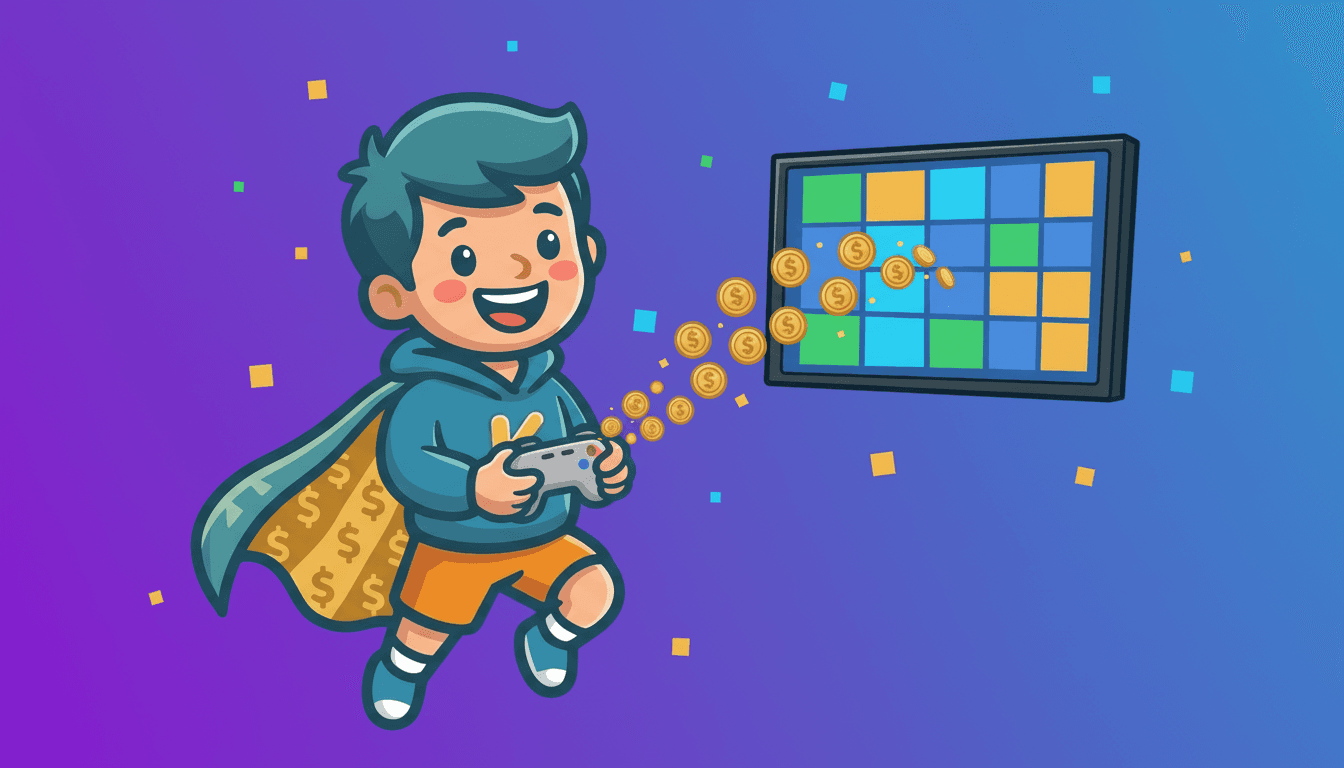
Roblox, V-Bucks, and Real Money: The In-App Purchase Conversation
Digital currency feels fake to kids. Here's how to make the connection concrete — before your credit card statement makes it for you.
Your kid has played Roblox for two hours a day for three months and still can't tell you how much a Robux is worth. That's not an accident. Games are specifically designed to obscure the exchange rate between real money and in-game currency, because confusion is what drives sales.
The problem isn't that kids play these games. It's that they're learning money habits inside an economy with no friction, no receipts, and no natural stopping point — and those habits transfer to real life.
Here's how to fix the disconnect without being the parent who ruined video games.
1. Make the Exchange Rate Explicit
Every in-game currency has a real-world dollar value. Your first job is to make sure your kid actually knows what it is.
- 100 Robux = $1.25
- 1,000 V-Bucks = $8
- 500 Minecoins = $2
- A Fortnite "battle pass" = $10, but also takes 100 hours of play to fully unlock
Do this exercise once: have your kid tell you how many Robux they have, then have them multiply it out to dollars. The reaction when a kid realizes they have "thirty dollars" of Robux sitting in an account is almost always: "wait, really?" That's the moment you were waiting for.
2. Use a Prepaid Card, Not Your Credit Card
The single biggest driver of accidental $400 credit card statements is a parent's card saved in the game's payment method. Remove it.
Replace it with a prepaid gift card or a prepaid digital card funded with an amount you both agreed on. $20 for the month, $50 for a birthday — whatever the number is, that's the ceiling. When it runs out, it runs out.
This does two things: it caps the damage, and it makes the purchase feel like a purchase. Clicking "buy" on a card with a finite balance feels completely different from clicking "buy" on an infinite credit card.
3. The Cost-Per-Hour Question
Older kids can handle a harder conversation: is this thing actually worth what it costs?
Take a specific purchase they want to make — a $15 skin, a $10 battle pass, a $20 emote bundle — and ask them to estimate how many hours they'll actually use it. Then divide.
- A $15 skin used for 10 hours = $1.50/hour
- A $10 battle pass played for 50 hours = $0.20/hour
- A $20 emote they use twice before getting bored = $10/hour
This isn't about shaming cheap purchases. It's about teaching them to think in cost-per-use, a framework that applies for the rest of their life — from a $200 jacket to a $15,000 car.
4. Earned Purchases vs. Gifted Purchases
Set a clear rule about which dollars can buy digital goods.
Some families say: your own money can buy whatever you want — Robux, skins, downloadable songs. Gift cards from birthdays can be used for digital purchases. But we don't spend family money on in-game currency. The logic is simple: in-game purchases lose their value the moment the server shuts down or the game loses popularity, so we don't use shared resources for them.
Other families say: earned chore money is for real-world goods only. If you want digital currency, it comes out of your allowance. The logic there: we want to nudge real-world saving over digital spending.
Either rule is fine. The bad version is having no rule, because then every purchase becomes a new negotiation.
5. The Refund You Already Have
Most platforms have a refund window that parents don't use because they don't know it exists. If your kid made a purchase that shouldn't have happened — accidental taps, a misunderstanding, a sibling on the wrong account — the refund is often available for up to 14 days.
- Apple: reportaproblem.apple.com, within 90 days
- Google Play: "Refund" link in the order email, within 48 hours for most purchases
- Roblox: contact support, harder but possible for first-time purchases
- Fortnite / Epic: three "self-service" refunds per account, no questions asked
Save this list. When the $80 surprise happens — and it will — you'll be glad you knew.
The Real Goal
The point isn't to make your kid feel guilty about spending money on games. It's to make sure that when they spend, they actually feel the transaction. A kid who knows that their new skin cost $15, and that $15 was five hours of babysitting, is a kid who's learning to value their own time and money.
That's the skill. Digital currency is just the new place to practice it.
Stay in the loop
We ship new free guides, printables, and the occasional deal — roughly twice a month. No spam, unsubscribe anytime.
Three streams available: 30-day welcome series, biweekly newsletter, and (opt-in) daily blog posts. Pick which you want after signing up. One click to unsubscribe from any.